Wednesday, February 7, 2007

A View of Tyndale House Library

Click on the graphic above to get a larger view. The desk I use is indicated by the dark circle. It faces Selwyn Gardens street.

The library is full. I
t receives about a thousand volumes each year. You may view plans for expanding the library area. Funds are needed to undertake this project.

Below is a picture of my study carrel. It's quiet. It's spacious. It's my study area for these many weeks while in Cambridge.


Today has been a productive day of research. Productivity, at this stage, is measured by how successful I am at locating and gathering resources that I have itemized on my bibliography. Given the stacks of resources, I would say I have been quite successful. Now I have to read all these items. That success will be measured differently and realized more slowly.

Tuesday, February 6, 2007

Senior NT Seminar Lectures

This morning I learned from fellow readers, here at Tyndale House, of an opportunity of which I intend to take advantage. At 2:30 pm, today, I expect to attend the lecture for February 6.

University of Cambridge

Faculty of Divinity
SENIOR NEW TESTAMENT SEMINAR
Lent Term 2007


The Seminar will take place in the Lightfoot Room at the Faculty of Divinity at 2.30 p.m.
on the following Tuesdays:
  • 23 January
    Dr Andrew Chester
    (Selwyn College)
    The Law of Christ and the Law of the Spirit

  • 6 February
    Prof. John Riches
    (Emeritus Professor, University of Glasgow)
    Westcott and the traditions of Cambridge New Testament scholarship Revisited

  • 20 February
    Prof. Ithamar Gruenwald
    (University of Tel Aviv)
    What can the New Testament tells us of the Judaism of its Time?
    A joint meeting with the Hebrew, Jewish and early Christian Studies seminar

  • 6 March
    Mr Jonathan Moo
    (Corpus Christi College)
    Roman 8.19-22 and Isaiah’s Cosmic Covenant

    Mr Ryan Jackson
    (St Edmund’s College)
    Cosmic Christology and New Creation Epistemology in 2 Cor 5

All welcome
GNS

Monday, February 5, 2007

Lost Sleep and Lost Memory in Cambridge

Lost sleep. Today has been less productive than I would have wished. I stayed up to late, until 1:00 am watching the first half of the Super Bowl game as the Bears and the Colts slogged it out. I watched with two friends, Barry Danylak and Trond Skinstad, with whom I attended Evensong at St. John's College chapel. Barry, having lived in Chicagoland, as I have, rooted for the Bears. Trond, on the other hand, is from Norway. That made it fun. He was learning the game of American football. As we watched, we enjoyed fine cheeses with crackers left over from a fancy reception for the launch of the Kirby Laing Institute for Christian Ethics, not the ordinary snack for watching a Super Bowl game.

I suppose that I should not have been surprised when I rose this morning to discover that the Bears lost. I hope to watch the other half of the game when I return home in March. John, my son, recorded it for me in high definition.

Well, now about losing memory. Before I left home for Cambridge, I had ordered an upgrade of RAM for my laptop computer. Unfortunately, it had not arrived before I left. Today, it arrived via DHL. I was eager to get it, hoping that it will ease some of the strain on the computer, given the increasing demands of software. Regrettably, I discovered that one stick of RAM is defective. Of course, to discover this took considerable amount of time and some alarm. I did not narrow it down to one stick without numerous attempts to sort out where the problem resided. Upon carefully and meticulous placing the RAM sticks into the computer, the laptop would not boot up. It simply ground away. At last, I received an alarming message, "system32\Drivers\Ntfs.sys" missing. Oh no! Now what do I do? Well I decided to place the original RAM back into the computer. VoilĂ ! It booted up properly. Thanks to Google, I after searching the web for
"system32\Drivers\Ntfs.sys," I discovered the likely problem. Bad RAM. Sure enough, one stick is no good. So, after having received the RAM upgrade, it unfortunately does not help my situation. The old RAM is back in the computer. Memory gained and memory lost, all in one day.


Sunday, February 4, 2007

Mathematical Bridge at Queen's College--A Sunday Afternoon Stroll

Research in the library is not possible on Sunday afternoon, given that the library is closed, and wisely so, for otherwise scholars would become more eggheaded than they already are. So, after having enjoyed a pleasant dinner with new friends, Don and Melissa Howell, in one of the flats at Tyndale House, I took a stroll through old Cambridge. I snapped the picture on the left of "Mathematical Bridge," spanning River Cam at Queen's College.

Mathematical Bridge strains under a load of several legends. It's a wonder that the bridge remains intact, given the weight of these myths. Here are some of the
myths that shroud the truth about the construction of the bridge:
  • That the bridge is of Chinese origin and that its design incorporates some form of special mathematical technique from which it derives its name.
  • That the bridge was designed and built by students. It was so perfect that the planks were laid one on top of the other and held together by their weight and the angles by which they were put together. The professors were so intrigued and in awe of its architecture that they took it apart to see how it was built. Their downfall was that they could not piece it back together again and therefore the bridge is now held together by nuts, bolts and screws.
  • That the bridge was designed by Isaac Newton, but that he did so without the need for bolts to hold the wood together - the story of college members then dismantling it and being unable to reassemble it is also part of this version of the myth. This version is unlikely to be true because Newton died in 1727, 22 years before the bridge was constructed.
The bridge connects to older segment of Queen's College (The Dark Side) with the newer portion (The Light Side).


Here are few other shots to acquaint you with Queen's College.On the left is the Gate House viewed from the Old Court. To the right is the Queen's College shield.


On the left is the cloister with the long gallery on the left. To the right is the President's Lodge. Finally, below is a shot of the bridge in winter, on a frosty morning, many of which we are having at this time.

For further information on Mathematical Bridge click here.


Saturday, February 3, 2007

Heavy Research Day. Anticipate Church Tomorrow.

As I close out my first week at Tyndale House, things are beginning to click for me. I'm learning the library system, how things are to be done, I've finally figured out the photo copy/scanner machine, and where various resources can be located. So, I've been gathering resources today and have been reading quite a lot.

Given the number of essays, books, and theses on one of my fields of resear
ch, the apostle Paul's view of the Mosaic Law, that have burgeoned since my last major research in the field, I am overwhelmed with volumes of materials. In order to maximize my research time in Cambridge, I fear that I may have to alter my intentions somewhat. I think I may need to narrow my research and be less ambitious about what I intended to accomplish. Instead of focusing upon revisiting the full subject of my dissertation (a study of the faith-works of the law antithesis in Galatians 3:1-14), I believe that I will use my allotted time more effectively if I narrow the focus of my work to concentrate upon three essays that I am scheduled to complete before the end of December 2007.

This is what a week's worth of research has done to me. It has confirmed what my wife knew all along, namely, that my designs were overly ambitious for a few weeks of research at Tyndale House.

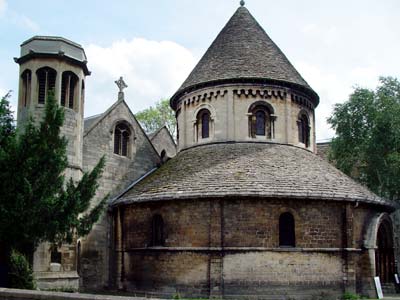
For tomorrow, I have been invited to join a fellow Tyndale House researcher and his wife to attend The Round Church at St. Andrews the Great, here in Cambridge. As I recall, my colleague, Dr. Jackie Glenny's
C.S. Lewis's Cambridge: A Walking Tour Guide begins at the Round Church. For future reference for anyone visiting Cambridge, here is a little blurb about the walking guide.

C S Lewis's Cambridge: A Walking Tour Guide, Jacqueline Glenny - The story of C S Lewis's translation to Cambridge and his last few years is charmingly told by Dr Jaqueline Glenny, an American academic. A Walking Tour Guide, which takes you on a tour of the town and is very well illustrated but also paints a fascinating portrait of Lewis the man as well as Cambridge.


Friday, February 2, 2007

New Acquaintances and One Old

What a small world! At tea this morning I struck up a conversation with a gentleman whose name is Kevin Conway, a theological educator in Croatia with a mission organization out of southern California. Kevin introduced me to two other gentlemen, Peter Lau from Australia (working on ethics in the book of Ruth) and Jason Fout (working on the glory of God in Christian theology).

Jason responded, "Actually we have met before." I'm sure my face showed great puzzlement, for I had no recollection of meeting Jason. He tested my memory, which is usually quite sharp, but I could not coax any recollections of seeing his face before. So, I begged, "Give me a context where we may have met." Jason responded, "College of Lake County." Talk about an obscure segment of my life! That was truly obscure. In the fall of 1988 I took a course in German as I was preparing to take the qualifying exam for my Ph.D. program. Jason, fresh out of high school, and I sat in the same classroom under the teaching of Herr Krupp. I, of course, have little recollection of students in the class, because I was on campus only to attend that one class three days each week.

Jason also knows another gentleman who is presently studying at Tyndale House. The two attended the same high school together. He is Jonathan Moo. Of course, I have a connection with Jonathan. His father, Douglas Moo, served as my first reader during the dissertation phase of my Ph.D. program. Douglas Moo is now Blanchard Professor of New Testament at Wheaton College.

Today, I received my University Centre card. It gives me access to university buildings, but especially to the University Center. It will be useful this evening when I go to th
e centre for dinner with a friend from Tyndale House, Barry Danylak, who is working on a Ph.D. through St. Edmund's College, but living and researching at Tyndale House. Before we go to the University Centre we plan to attend Evensong at St. John's College, which is reputed to have an excellent male choir. I shall hear for myself this evening. Come to think of it, I do not have to wait until this evening. I can listen now, which I am doing on-line. I am listening to the Epiphany Carol Service 2007. You may listen as well.

Thanks for stopping by to read my journal.


Thursday, February 1, 2007

Inescapable Inequality

I have been busy with research today. During the course of my day I came upon the following from a British minister, J. C. Ryle, from the nineteenth century. He was educated at Oxford, not Cambridge. Below is a portion of his exposition of The Parable of the Rich Man and Lazarus.

“There was a rich man who was dressed in purple and fine linen and lived in luxury every day. At his gate was laid a beggar named Lazarus, covered with sores and longing to eat what fell from the rich man's table. Even the dogs came and licked his sores. The time came when the beggar died and the angels carried him to Abraham's side. The rich man also died and was buried. In hell, where he was in torment, he looked up and saw Abraham far away, with Lazarus by his side” (Luke 16:19-23).

J. C. Ryle (1816-1900) was an evangelical Bishop who knew how to apply the teaching of the Scriptures to the society in which people lived. In this extract from his work Practical Religion he challenges the developing ideology which claimed that all men should be equal in wealth. Ryle countered such arguments by demonstrating that inequality is a fact of life in a fallen world and can be an instruction toward challenging character development in the poor and the rich.

Many in every age have disturbed society by stirring up the poor against the rich, and by preaching the popular doctrine that all men ought to be equal. But so long as the world is under the present order of things this universal equality cannot be attained. Those who speak against the vast inequality of men’s fates will doubtless never lack an audience; but so long as human nature is what it is, this inequality cannot be prevented.

So long as some are wise and some are foolish-some strong and some weak-some healthy and some diseased-some lazy and some diligent-some prudent and some careless; so long as children reap the fruit of their parent's bad behavior; so long as sun, and rain, and heat, and cold, and wind, and waves, and drought, and plague, and storms are beyond man’s control-so there will always be some rich and some poor. All the political order in the world will never erase the fact that, “There will always be poor people in the land.” [Deuteronomy 15:11]

Take all the property in our country by force this very day, and divide it equally among the inhabitants. Give every man above the age of twenty an equal portion. Let everyone share and share alike, and begin the world over again. Do this, and see where you would be at the end of fifty years. You would have just come back around to the point where you began. You would find things just as unequal as before. Some would have worked, and some would have been lazy. Some would have always been careless, and some always scheming. Some would have sold, and others would have bought. Some would have wasted, and others would have saved. And the end would be that some would be rich and others poor.

Let no one listen to those vain and foolish talkers who say that all men were meant to be equal. They might as well tell you that all men ought to be of the same height, weight, strength, and skill-or that all oak trees ought to be of the same shape and size-or that all blades of grass ought to always be the same length.

Settle it in your mind that the main cause of all the suffering you see around you is sin. Sin is the great cause of the enormous luxury of the rich, and the painful degradation of the poor-of the heartless selfishness of the highest classes, and the helpless poverty of the lowest class. Sin must first be cast out of the world. The hearts of all men must be renewed and sanctified. The devil must be locked away. The Prince of Peace must come down and take His great power and reign. All this must be done before there can ever be universal happiness, or the gulf filled up that now divides the rich and the poor.

Beware of expecting a millennium to be brought about by any method of government, by any system of education, or by any political party. Work hard to do good to all men. Pity the poor, and help in every reasonable endeavor to raise them from their life of poverty. Seek to help to increase knowledge, to promote morality, and to improve the earthly condition of the poor. But never, never forget that you live in a fallen world, that sin is all around you, and that the devil and the demons are everywhere. And be very sure that the rich man and Lazarus are emblems of two classes, which will always be in the world until the Lord returns.

J. C. Ryle, Practical Religion (from chapter 13).

Brief comment: The fact that we live in this fallen world where inequities abound, where wealth and poverty reside adjacent to one another, provides ample opportunity to conduct ourselves as Christians, extending love and kindness indiscriminately to both the wealthy and the poor and to people who fall along every other kind of disparity and inequity.