Saturday, February 24, 2007
Panoramic View from Tower of Great St. Mary's Church
Tuesday, February 20, 2007
TV License Fees, Electronic Snooping, and Police State.
Today I learned at a Tyndale House residents' meeting that the £131.50 (approx. $262.00) per annum fee is not voluntary in the sense that residents pay the tax to keep a clear conscience. No. No. There are government vehicles that patrol streets and roads with electronic snooping equipment to check whether one's residence is emitting telltale signals that indicate that a television is operating and tuning into channels. If so, expect to receive notice and pay up.
Are you considering taking up residence in the UK for a few months and you plan to use a television? Here is the page for you to consult. English is not your mother tongue? No problem. There are links for numerous languages so that you can read the web pages in your own language.
If you want to obtain a general overview of the television user fee license, Wikipedia offers a good beginning point here.
Incidentally, during our residents' meeting, when we were told about the government vehicles that snoop about to detect whether residents' televisions are tuned into channels or simply playing DVD or VHS movies, one resident quipped, "That's like a police state!" Touché.
Fellow Americans, our television tax is more concealed. There is a television and radio tax. You did know that. Right? Oh yes. It simply is more veiled in that Congress allocates collected tax revenues to fund National Public Radio and Public Television. It is a less direct tax than here in the UK. We do not pay a direct tax, nor do we acquire a license to operate our television sets. Thank God! We pay a price, of course. We endure more commercials, but then commercials actually do serve various purposes. Now, don't they?
Monday, February 19, 2007
Pembroke College, Founded 1347

Various fellows of Pembroke suffered as martyrs during the Reformation period. Nicholas Ridley, after whom Ridley Hall is named, refused to renounce his
Protestant faith and perished under Queen Mary I, the Catholic monarch. Americans know of a renowned graduate from Pembroke, Roger Williams, who founded Rhode Island.
On the left above is the library. To the right is the old court. Below left is the chapel which replaced the first chapel. The present chapel, designed by Christopher Wren, his first architectural commission, was put into service in 1690.
For more pictures of Pembroke click here
Saturday, February 17, 2007
Peterhouse, Oldest College in Cambridge
The foundation of Peterhouse dates from 1280, when Hugo de Balsham, the Bishop of Ely, planned to start a college on land that is now part of St. John’s College. In 1284
, he transferred to the present site with the purchase of two houses to accommodate a Master and fourteen “worthy but impoverished Fellows”, and Peterhouse was founded. A hall was built two years later; this is the oldest college building in Cambridge. Balsham died in 1286, bequeathing a sum of money that was used to buy further land.
In the early seventeenth century, under the Mastership of Andrew Perne, the College was known as a center for Arminianism.
Would you like to see more of Peterhouse. Here are three ways to see more. Take a Virtual Tour of the college, view the Peterhouse Photo Album, or view the 3-D Map.
To the left are the chapel doors. Observe the date on the right hand door, 1630. Above and to the right is the chapel interior. To the right is the court from the chapel doors.
Below is the Master's Lodge, built in 1702 by a Peterhouse Fellow, Dr Charles Beaumont, for his own residence. He willed the house to the college, and upon his death in 1727, the college occupied the house as the Master's Lodge and has done ever since.
Friday, February 16, 2007
The Fitzwilliam Museum
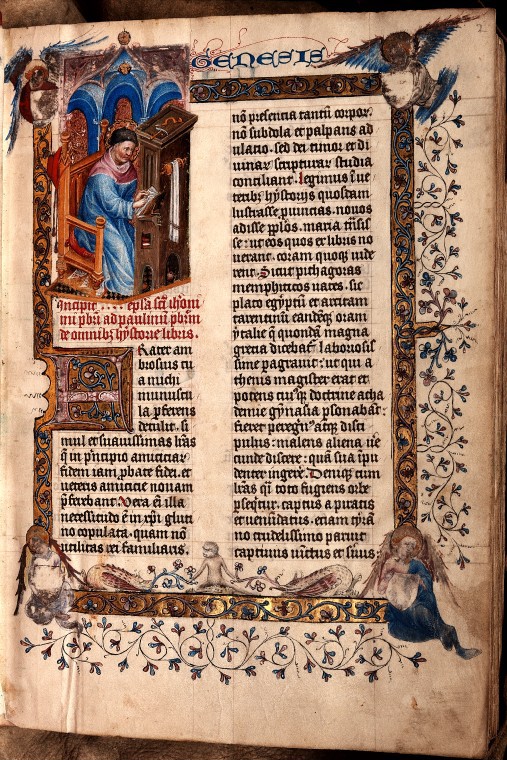
to see. I look forward to returning to the museum to continue working my way through other collections. In particular, I hear that the museum has a nice collection of illuminated Bibles. Some of you may wonder what an illuminated Bible is. Here is a picture of a page from an illuminated Bible. "Illuminated" is the term antiquarians use. "Illustrated" is the term lay folks might use. Most illuminated Bibles and prayer books date from the Middle Ages. Skilled scribes adorned manuscripts, Bibles and prayer books, with pictorial or graphical designs, with borders, with ornate initial letters, or with miniature pictures in colors and gold.Monks at Saint John's University in Collegeville, Minnesota, took on a variation of a modern scriptorium by preserving Medieval illuminated Bibles and Books of Heures (prayer books) through microfilm and microfiche. For anyone interested in their work, it is well worth a stop. The monks are pleased to accommodate visitors.
Monday, February 12, 2007
A Tribute to Two Great Men: Abraham Lincoln & William Wilberforce
On this day, February 12, it is fitting and proper that we should honor two men who shared a portion the same century, the nineteenth, but were separated by an ocean, accomplis
hed the extraordinary The story of William Wilberforce's labors to bring slavery to an end in the British Empire is told in the movie to be released this month (Feb 23, 2007), Amazing Grace, the account of the influence Jo
hn Newton, former slave ship captain had upon Wilberforce. This is the bicentenary of John Newton's death. Dying on December 21, 1807, the former slave ship captain lived long enough to see slavery en
ded in his beloved homeland and throughout the British Empire.William Wilberforce is one of many favorite sons and graduates of St. John's College, Cambridge University. Suitably, St. John's College Chapel narthex features a marble statue of William Wilberforce seated.
For an account of factors that played roles in Wilberforce's conversion to follow Christ Jesus, look here.
Thanks to the labors, courage, and sacrifice of William Wilberforce and Abraham Lincoln, our world is quite different from what it once was. Slavery is no more in Britain and America. Most regrettably, slavery persists in altogether too many places in the world, most notably in Africa, where Muslims continue to enslave non-Muslim Africans. For further details, read The Unknown Slavery: In the Muslim world, that is -- and it's not over.
Sunday, February 11, 2007
A Beautiful Sunday Afternoon in Cambridge
When I emerged from church, it was obvious that I would not need my umbrella today. What a beautiful day in Cambridge! The temperature was around 55 to 60 Fahrenheit, perfect for a Sunday afternoon
stroll about Cambridge. First, I took a tour of the King's College Chapel, begun in 1441 and completed in 1547. What an exquisite structure! I learned that the stained glass windows, which took 30 years to complete, were removed piece by piece and store
d in a safe place throughout the duration of World War II. The windows are priceless. They depict the biblical narrative, Old Testament on the upper portion of the panels and the NT on the lower portion. Click on the picture to the right to read the description of the windows.As beautiful as the windows are, the elegance of the ceiling is the definitive feature of the Chapel. The ceiling consists of interlaced ornate ribbing that form fans. Keep in mind that the ceiling is 80 feet high. Imagine the scaffolding required to hold the artisans who constructed the ceiling. If you ever come to Cambridge, you will want to tour King's College Chapel. It is truly grand!

Another cathedral in England that features this exquisite fan vault is the Bath Cathedral.
Sunday afternoon was still young when I had to leave the Chapel, due to an Evensong service that was scheduled to begin shortly. So, I continued on to several other colleges, but I will tell more of these at another time and offer some pictures as well.
Sunday, February 4, 2007
Mathematical Bridge at Queen's College--A Sunday Afternoon Stroll
Mathematical Bridge strains under a load of several legends. It's a wonder that the bridge remains intact, given the weight of these myths. Here are some of the myths that shroud the truth about the construction of the bridge:
- That the bridge is of Chinese origin and that its design incorporates some form of special mathematical technique from which it derives its name.
- That the bridge was designed and built by students. It was so perfect that the planks were laid one on top of the other and held together by their weight and the angles by which they were put together. The professors were so intrigued and in awe of its architecture that they took it apart to see how it was built. Their downfall was that they could not piece it back together again and therefore the bridge is now held together by nuts, bolts and screws.

- That the bridge was designed by Isaac Newton, but that he did so without the need for bolts to hold the wood together - the story of college members then dismantling it and being unable to reassemble it is also part of this version of the myth. This version is unlikely to be true because Newton died in 1727, 22 years before the bridge was constructed.
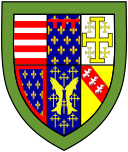
Here are few other shots to acquaint you with Queen's College.On the left is the Gate House viewed from the Old Court. To the right is the Queen's College shield.
On the left is the cloister with the long gallery on the left. To the right is the President's Lodge. Finally, below is a shot of the bridge in winter, on a frosty morning, many of which we are having at this time.
For further information on Mathematical Bridge click here.